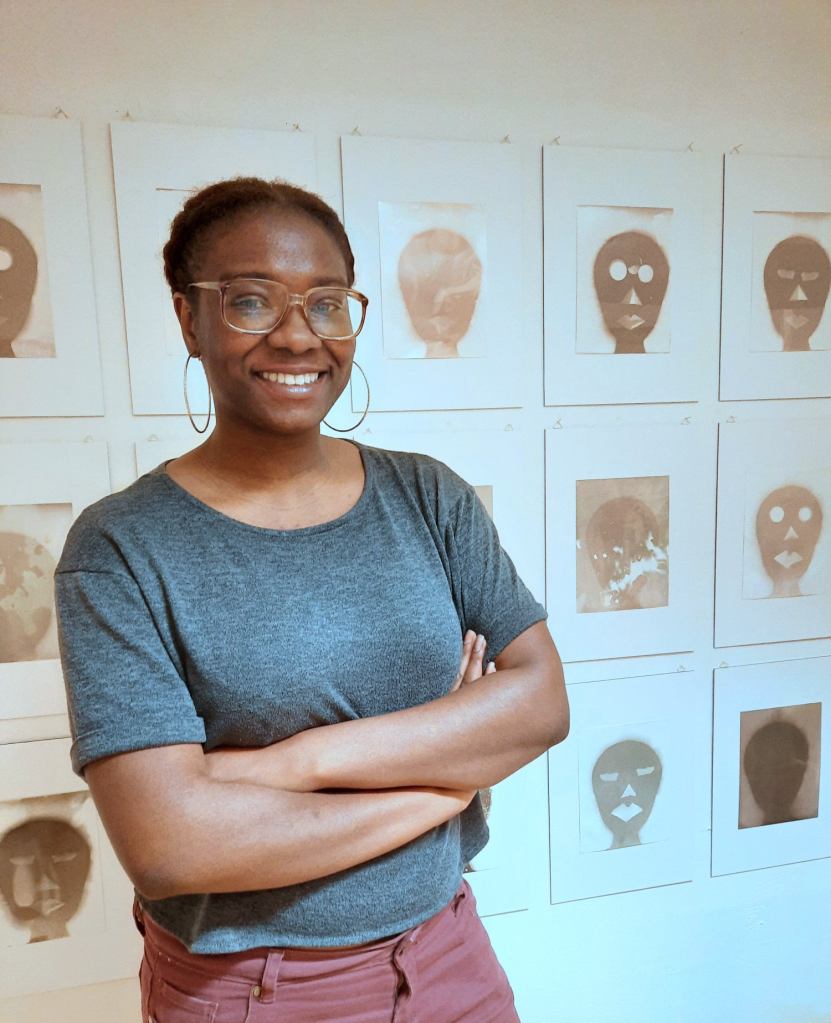
Flat Octopus visited the studio of the artist Diana Agunbiade-Kolawole (b.1988 Nigeria) based in Stockholm and London. Diana holds an MFA from the Royal Institute of Fine Art in Stockholm, a BA in Photography from Kingston University, London, and studied at École Nationale Supérieure des Beaux-Arts, Paris. Her work has been exhibited at the Nigerian High Commission, London; Tate Britain, Centre Pompidou, and in Sweden in Färgfabriken, Thielska Gallery, Konstakademien, Växjö Konsthall, Galleri Thomassen and Loyal Gallery.
It is hard to sum up Diana’s varied multi-dimensional practice and sparkling personality in a few sentences. Photography overlaps with performance and print, the serene and spiritual merges with playful and process-oriented, always surprising and never static. Talking with Diana feels like getting a large energy shot; she is an admirable artist, determined to overcome any obstacle that comes her way with a smile and motivation to share.
We got to see a large amount of Diana’s different projects, probably the most prominent among them the ‘Honest Portraits’, a series of photographic performances attempting to find the very core of what a true, truthful portrait really is; how it is created and what contributes to its honesty. Of course, a discussion ensued on whether a representation of another person ever can be ‘honest’ – and from whose perspective. The portraits are presented in two stages: during their creation in live performances where photographic chemicals are placed on the artist’s body or breathed on photographic paper, and as a resulting work – remnants – which are not fixed and remain in constant flux, carrying on their performativity.
Less process-based, more introspective, and spiritual works are demonstrated in the ‘A Body of Work’, small playful collages that are contrasted with ‘A Body of Work – Masks’, a series of twenty-four masks developed with a phone light in the artist’s bathroom. It was interesting to compare those with Diana’s other works, like a juxtaposition of clashing character traits, of things we prefer to keep to ourselves or reveal to others.
You can see Diana’s work currently in the group exhibition “Någon sorts kunskap – fotografi ur och av samlingar” at Västerås Konstmuseum. Below our Q&A with the artist.
Can a portrait ever be honest? Who decides?
–I think a portrait can be honest, but I am interested in consistency in honesty. A portrait is honest for the moment it’s required to be, its decisive moment. This means that a portrait will always be judged by the moment when it is shot, although the future may discredit its history rendering that moment invalid.
What is the purpose of masks in your work – are they the other side of honest portraits, or simply a different kind of honesty?
–The Masks started off as a way to be productive, focused on the need to be busy and occupy myself. At that point it was a tough time for me; I wasn’t so keen on going out and my studio felt too far to go to. But I still wanted and needed to produce art, therefore I started to make some sketches at home so that I didn’t feel completely redundant and lazy.
The sketches became a series of masks all made with the same objects with only the eyes transforming. The combinations yielded multiple expressions, these changes led me on to continue working with them. There are multiple truths, it depends on which perspective one takes. To contradict the previous comment – there are no other sides to the truth in the Honest Portraits.
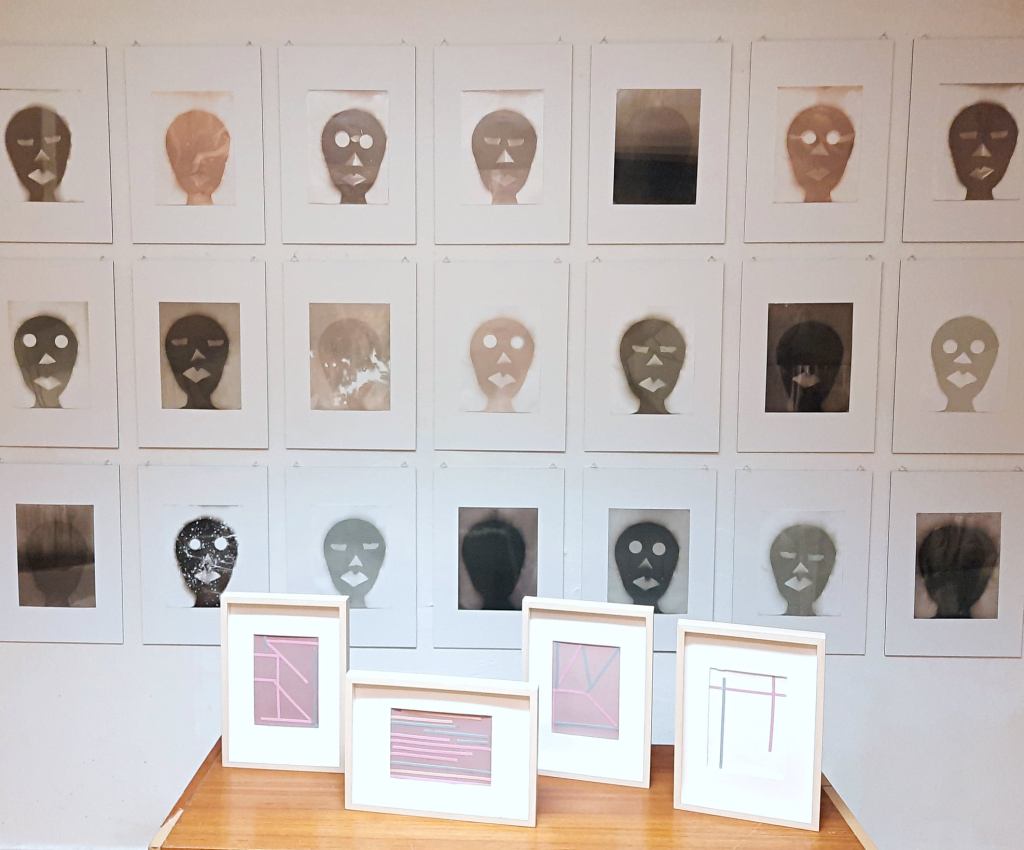
Diana Agunbiade-Kolawole, A Body of Work and A Body of Work – Masks, coloured photo paper; black and white photo paper, 2020–2021, photo: Alice Máselníková
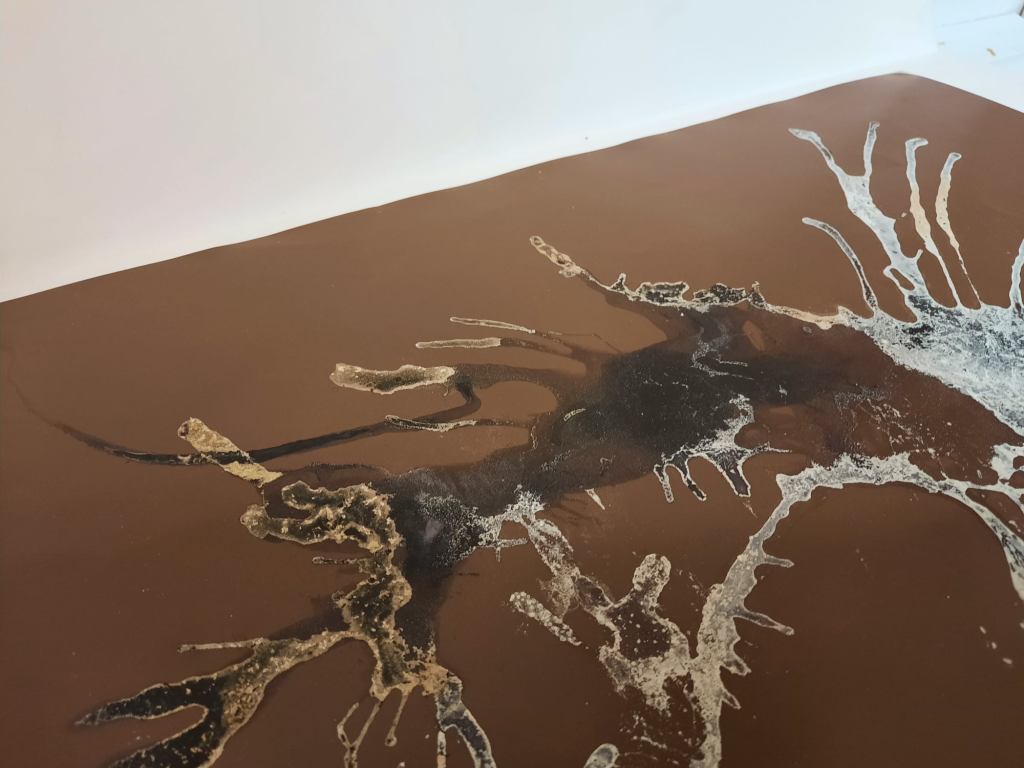
Diana Agunbiade-Kolawole, Honest Portrait, copy proff photo paper with phosphorescent pigment, black and white developer, photo: Alice Máselníková
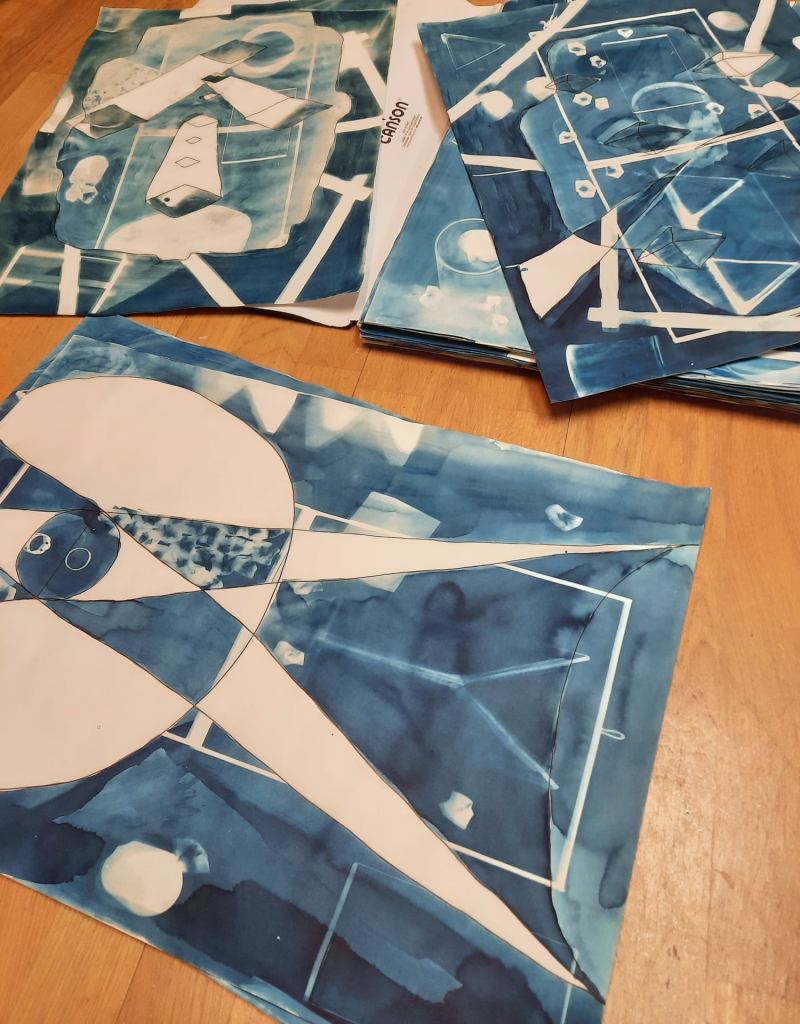
Diana Agunbiade-Kolawole and Johan Franzén, Of Blue, ink drawing and cyanotype on paper, photo: Alice Máselníková
 Flat Octopus